InvestigateIt
Prague
You’ve seen the whole case file.
The next one is yours.
—Simon, the founder
Map it. Track it. Get notified the moment it changes.
Not the research: the shuttling of it from app to app. A name retyped in four windows, the thread of the case dropped between tabs.
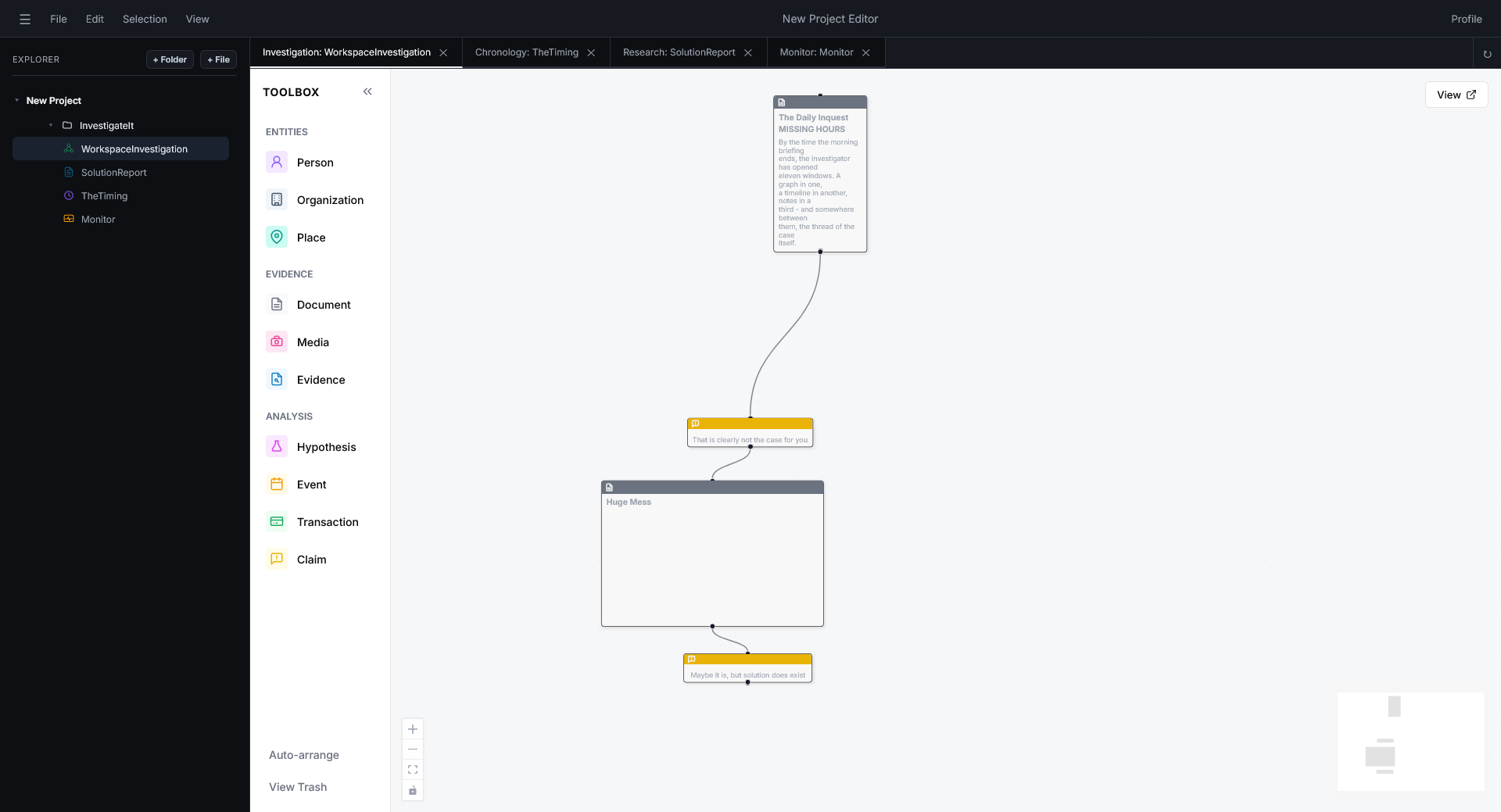
That is clearly not the case for .
Maybe it is, but solution does not exist.
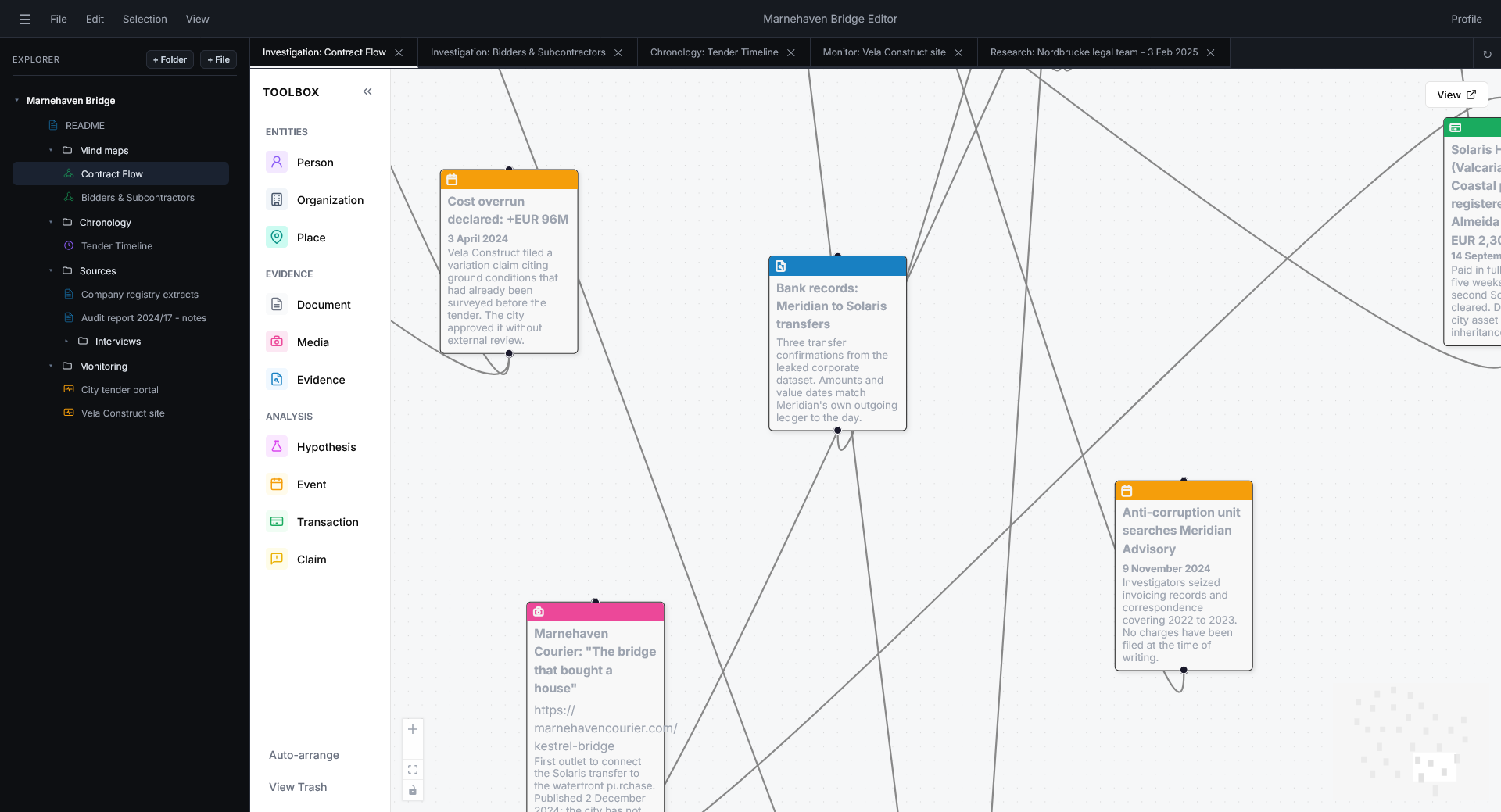
Documents, people, places and claims are nodes on one canvas. The connections between them are the case. Link a claim to its source once and the link holds: when a document falls apart, you see every assertion that falls with it.
Every dated fact in the project takes its place on a single chronology the moment it is captured. Contradictions surface as overlaps. And the gaps, the missing hours, finally become something you can look at.
Notes, transcripts and the piece itself are written inside the case, in a real editor: headings, lists, quotes, tables and code. The draft sits next to the evidence it rests on, so the writing and the investigation stop being two jobs in two applications.
Point the monitor at the pages, profiles and registries that matter, and it watches them quietly, archiving every version, diffing what changed, and filing each one to the case with the time it was captured.
A finding does not have to leave the case to reach a colleague. Post a piece of the map, a claim or a page of the draft to the project feed, and the discussion happens against the evidence itself, not in a chat window three applications away.
Everything you write in the workspace will be encrypted on your own machine. The key that opens it will never reach our servers. You won’t have to trust us on that: the part that runs on your computer will be open source.
You’ve seen the whole case file.
The next one is yours.
—Simon, the founder
Not the research: the shuttling of it from app to app. A name retyped in four windows, the thread of the case dropped between tabs.
The entire investigation, in one encrypted workspace.
Your entire OSINT workflow in one seamless workspace.